
of Indian consumers in PwC's 2023 India survey used a search engine as a top source of pre-purchase information.
PwC Global Consumer Insights Pulse Survey: India perspective, 2023EightArrow learning centre · Small-business guide
Digital marketing is no longer optional visibility. It is part of how customers decide.
A practical, research-informed guide to digital marketing in India: how people discover products and services, why Google Search and Maps matter, what social media can and cannot do, how reviews shape trust, and where marketing is heading next.
Educational guide · India-focused · Reviewed November 2026
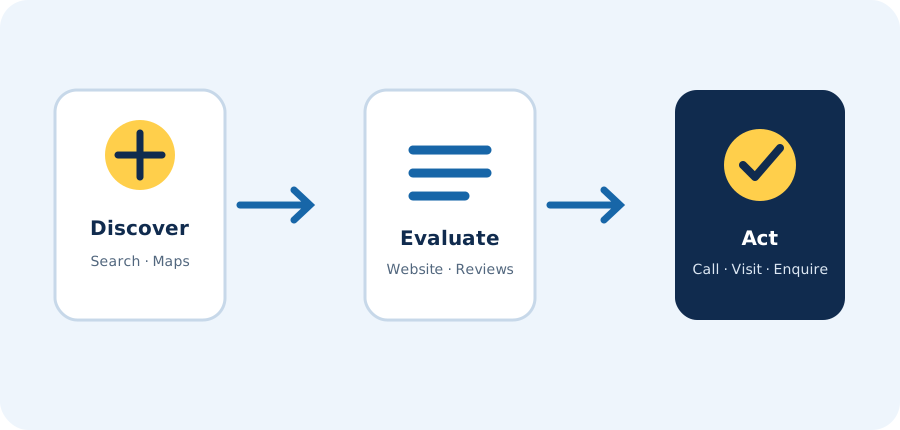
Start with a simple truth
Customers may meet your business online before they ever meet you.
For a local shop, repair service, clinic, consultant, restaurant or home-service provider, the first interaction may be a Google search, a map listing, a review, a social post, a website or a message shared by someone they trust. Digital marketing helps a business show up in those moments with accurate information and a credible presentation.
of surveyed consumers in PwC's 2024 purchase-journey study used search engines to research products.
PwC Voice of the Consumer Survey, India, 2024of India's total advertising spend in FY2025 went to digital advertising, according to the ET Brand Equity–Ipsos report.
ET Brand Equity–Ipsos, State of Digital Marketing in India 2025–26These figures come from different studies, samples and years. They are evidence of a changing environment, not a promise that every customer or every local market behaves identically.
How digital marketing evolved
From one-way advertising to measurable, connected customer journeys.
Marketing has always been about connecting a useful offer with a person who may need it. What changed is the number of places where discovery and evaluation happen—and how quickly customers can compare alternatives.
Local reputation and traditional media
Word of mouth, shopfronts, newspapers, pamphlets, radio, outdoor hoardings, directories and local events helped businesses reach nearby audiences. These methods still have roles, especially for broad awareness and community reach.
Websites and search engines
Businesses began publishing information online. Search engine optimisation, business directories, email marketing and early online advertising helped customers find details beyond a physical storefront.
Maps, smartphones, social platforms and reviews
Customers could compare businesses while travelling, check photos and opening hours, read reviews, watch demonstrations and contact businesses instantly. Local search and mobile-friendly websites became more important.
More conversational discovery and faster analysis
AI tools can summarise information, support research, help create drafts and assist customer service. Businesses still need accurate facts, original expertise, privacy-aware practices and human judgement.
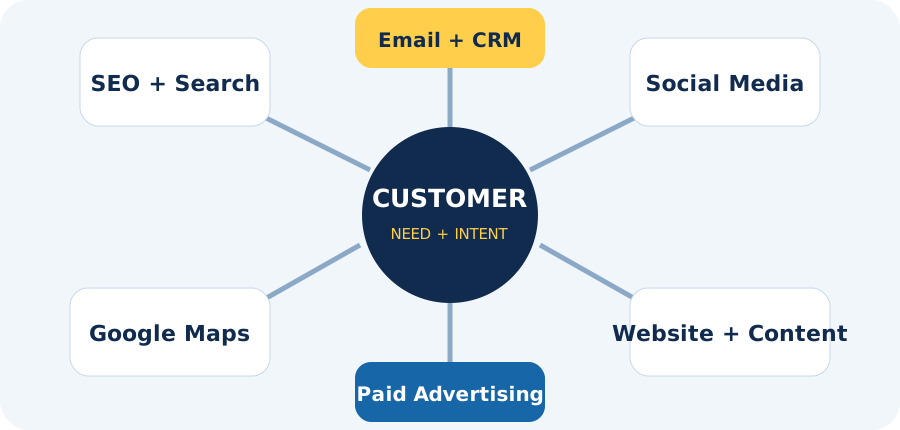
The digital marketing mix
Different channels do different jobs. They are not interchangeable.
Effective digital marketing is not simply being everywhere. It is choosing the channels that match the customer's intent, the business model, the budget and the ability to respond.
Search engine optimisation (SEO)
Improving useful pages so search engines can understand them and people can find relevant answers. Includes technical SEO, on-page SEO, content quality, internal links, structured data and off-page authority.
Explore Local SEOGoogle Business Profile and local SEO
Managing business details, categories, services, photos, updates, reviews and location information so eligible local businesses can appear across Google Search and Maps. A profile is free to create; professional setup and management services may cost money.
Explore Google Business ProfileWebsite development and landing pages
A website gives customers a place to understand services, compare information, see proof, answer questions and contact the business. Good web design, mobile usability, accessibility, speed and clear calls to action matter.
Explore website developmentSocial media marketing
Social media management, organic social content, community engagement, short-form video and social media advertising can build familiarity and demonstrate expertise. Posting volume alone is not a strategy.
Explore social media managementContent marketing and content creation
Useful articles, service explainers, FAQs, photographs, videos, captions, case studies and guides answer customer questions and support search and social discovery. Content should be accurate, relevant and made for people.
Explore content creationPaid search and Google Ads
Paid search can place ads in front of people searching for selected terms. It offers budget control and measurable campaigns, but costs vary by competition, industry, location, audience and keyword. Clicks are not the same as customers.
Explore Google AdsEmail marketing and customer relationship management
Permission-based email, messaging and CRM help businesses nurture existing enquiries, share useful updates and manage follow-ups. Respect consent, privacy and unsubscribe requirements.
Online reputation and review management
Reviews help people assess real customer experiences. Encourage honest feedback, respond professionally and resolve service issues. Never buy, fabricate or selectively manipulate reviews.
Analytics, conversion rate optimisation and reporting
Use suitable analytics and conversion tracking to understand traffic sources, calls, form submissions, direction requests and customer actions. Measure what matters to the business, not just likes or impressions.
Video, influencer, affiliate and marketplace marketing
Demonstrations, creator partnerships, referrals, marketplaces and online listings can help when they fit the product, audience and economics. Disclose paid relationships and track the quality of resulting enquiries.
Traditional advertising vs digital channels
Why some small businesses are rethinking newspaper and print advertising.
Newspaper ads, pamphlets, radio and outdoor media can still be useful for local awareness, launches, events and audiences who consume those channels. The problem is relying on them alone when customers increasingly research online before contacting a business.
Traditional print placement
- Can reach a broad local readership at a set time.
- Often has fixed placement, size and publication costs.
- May be difficult to attribute calls or sales without a unique phone number, offer or QR code.
- Visibility is temporary; the ad may not answer a customer's later search.
Google Business Profile + website foundation
- A Business Profile can be created and managed at no charge by the business.
- Accurate hours, services, photos, reviews and contact details can be available when customers search.
- A website can explain the offer in depth and support enquiries beyond the profile.
- Performance can be reviewed using profile interactions, website analytics and enquiry records.
Cost comparison: Google Business Profile itself is free; it is not equivalent to paid Google Ads. Staff time, photography, website development and professional profile management can still have costs. Google Ads charges for advertising interactions such as clicks, with costs influenced by auction conditions and campaign settings. No channel guarantees enquiries.
For a small local business, building a complete, accurate Google Business Profile and a useful website can be a more durable starting point than repeatedly paying for short-lived print placements. This is a strategic comparison, not a claim that print is always ineffective or that a profile guarantees customers.
See the Google Profile + Website approachIndia's changing customer behaviour
People still ask people. But increasingly, they also search, compare and verify.
It would be inaccurate to say Indians no longer ask friends, family or neighbours. Word of mouth remains important. The shift is that digital research now often happens alongside recommendations and sometimes before a customer makes contact.
Search is part of pre-purchase research
PwC reported that around five in ten Indian consumers frequently or almost always used smartphones in-store to compare prices or view live product reviews. Search engines and e-commerce sites were major pre-purchase information sources.
Read PwC India findingsResearch happens across channels
PwC's 2024 survey found that consumers use search engines, social media, brand websites, marketplaces, news and in-person experiences at different stages of discovery, research and purchase.
Read the PwC reportDigital has become a major advertising medium
The ET Brand Equity–Ipsos report estimated India's FY2025 digital advertising spend at ₹49,000 crore, 44% of total advertising spend, with year-on-year growth of 20%.
Read the Ipsos report summary
Small shops and service businesses
Digital marketing is not only for large brands or online stores.
For a neighbourhood pharmacy, repair shop, salon, cake studio, electrician, clinic, restaurant or specialist service provider, the digital journey can be very practical: a customer needs something, searches for options, checks whether the business looks credible, then calls, messages or visits.
Repair and home services
Customers may search by service and location, compare response times, read reviews and look for proof of expertise. Clear service pages, accurate service areas, a well-managed profile and easy contact options reduce uncertainty.
Retail shops and pharmacies
Customers may check opening hours, directions, product availability and trust signals before visiting. Keep information accurate and avoid making unsupported health or product claims.
Food, cakes and hospitality
Photos, menus, location, ordering information, reviews and social content help customers judge whether the offer suits an occasion or need. Visual presentation must reflect the real product.
Professional and specialist services
Explain the problem solved, the process, credentials where relevant, service scope and how to enquire. Helpful educational content can attract more qualified enquiries than generic promotional posts.
The small-business trap
Starting late, stopping early, then trying everything alone.
A common pattern is to delay digital adoption until competitors are visible online. A business then hires help, expects instant results, stops before the strategy has enough time or evidence to be evaluated, and tries random tactics independently. The business loses continuity—not necessarily because an agency is always right, but because marketing needs ownership, realistic expectations and consistent execution.
Wait too long
Rely only on walk-ins and existing contacts while customer discovery changes.
Expect instant results
Assume a profile, website or a few posts will immediately produce steady sales.
Stop without learning
End work before reviewing implementation quality, enquiries, conversion and market conditions.
Post randomly
Switch to unplanned graphics and tactics without research, consistency or measurement.
The better approach is partnership and clarity.
The business owner brings product knowledge, service quality, customer relationships and sales execution. A marketer brings research, positioning, channel strategy, creative direction, technical setup and measurement. Both need to communicate and take responsibility for their part.
Reviews and reputation
Reviews are not decoration. They are part of how people reduce risk.
Before contacting an unfamiliar business, customers may look for recent feedback, photos, detailed experiences and the way the business responds to problems. A review profile cannot replace service quality, but it can influence whether someone feels confident enough to make contact.
Earn genuine feedback
Ask customers for honest reviews after a real interaction. Make the process simple and never offer rewards in exchange for positive ratings.
Respond with care
Thank customers for useful feedback. For complaints, acknowledge the concern, avoid exposing personal information and offer a suitable offline resolution.
Learn from patterns
Look for repeated comments about delays, communication, quality, pricing clarity or after-sales support—and improve the underlying experience.
Marketing and sales work together
Marketing can create the opportunity. The business still has to earn the sale.
Digital marketing can improve discovery, explain value, build confidence and generate calls, messages, visits or form submissions. It cannot by itself guarantee that a customer buys. Product quality, pricing, availability, staff behaviour, response speed, follow-up, negotiation and customer experience all affect conversion and repeat business.
Marketing+Customer experience+Sales execution=Business outcomes
A useful measurement system follows the full journey: qualified visibility → enquiry → response → visit or consultation → sale → repeat purchase or referral. Track each stage where practical.
The current landscape
Digital marketing is growing—but attention is fragmented and competition is real.
India's digital advertising growth creates opportunity, but it also means more advertisers compete for attention. Paid acquisition costs can rise, platforms change formats and algorithms, and audiences become tired of repetitive promotions. A small business needs a channel mix it can sustain—not an assumption that every platform deserves a budget.
Search and local intent
People with an immediate need may use search and maps to compare nearby options. Local relevance, accurate details, proximity, prominence and helpful information matter.
Social discovery
People may discover products through reels, videos, creators and community posts. Discovery does not always mean purchase intent; the next step must be clear.
Paid media economics
Google Ads and social advertising can scale reach, but require targeting, budgets, creative testing, conversion tracking and follow-up. Monitor cost per qualified enquiry, not only clicks.
Trust and privacy
Transparent claims, authentic reviews, consent-aware communication and responsible data handling are essential to long-term trust.
The future of digital marketing
More AI, more automation—and a greater need for authenticity.
AI-assisted search, conversational interfaces, automated campaign optimisation, generative creative tools, predictive analytics and customer service automation will keep changing how marketing work is performed. The durable advantage will not be publishing more machine-generated content. It will be understanding customers, offering real value, maintaining accurate information and using technology responsibly.
AI-assisted research and production
Use AI to organise research, explore questions, draft variations and analyse patterns. Verify facts, protect confidential data and retain human editorial judgement.
Search beyond ten blue links
Search experiences may include summaries, maps, videos, product results and conversational answers. Clear, trustworthy, structured information and genuinely helpful content remain important.
First-party relationships
Businesses will benefit from permission-based customer relationships, useful follow-up, service records and a better understanding of repeat needs.
Measurement that connects to revenue
Better attribution and CRM integration can help connect marketing activity with qualified leads, sales and customer lifetime value—when data is collected responsibly.
Technology changes. The fundamentals do not.
Know the customer. Solve a real problem. Explain the offer clearly. Be easy to find. Earn trust. Respond promptly. Deliver what was promised. Learn from evidence.
A practical starting framework
What should a small business do first?
Make the business findable
Claim and accurately complete the Google Business Profile if eligible. Confirm categories, hours, contact details, service areas, photos and services.
Create a useful website
Explain the services, location or service area, proof, FAQs and contact methods. Ensure mobile usability, fast loading and clear navigation.
Choose channels based on customers
Use search, social media, content, email or paid ads where they match actual customer behaviour and available resources.
Build a credible reputation
Deliver good service, request honest reviews and respond professionally. Never manufacture testimonials or ratings.
Measure enquiries and sales
Track calls, messages, direction requests, form submissions, qualified leads and sales. Improve the weakest step in the journey.
For a practical local-business foundation, see our guide to Google Business Profile and website marketing, or explore EightArrow's services.
Frequently asked questions
Digital marketing questions small businesses ask.
What is digital marketing?
Digital marketing is the use of online channels and technologies—such as search engines, websites, maps, social media, email, online advertising, content and analytics—to help an organisation reach, inform, serve and retain customers.
Is Google Business Profile free?
Google states that creating and managing a Business Profile is free. Optional services such as professional setup, optimisation, photography, website development and ongoing management may have fees. Google Ads is a separate paid advertising platform.
Is SEO better than Google Ads?
They serve different purposes. SEO can build organic visibility over time; Google Ads can provide paid exposure while a campaign is funded. Many businesses use a combination, based on goals, competition, budget and conversion performance.
Do small businesses need a website if they have social media?
A social profile is useful, but a business website gives more control over service information, navigation, search visibility, content, analytics and customer journeys. The right choice depends on the business, but the two can complement each other.
Can digital marketing guarantee sales?
No. Marketing can generate visibility and enquiries, but sales also depend on the offer, pricing, customer need, service quality, availability, response and sales process. Responsible marketers do not guarantee rankings or sales.
How long does digital marketing take to work?
There is no universal timeline. Paid campaigns can generate traffic quickly when set up well, while SEO, reputation and content development generally require sustained work. Results depend on the market, competition, website, budget and execution.
Should every small business use every social platform?
No. Select platforms based on customer behaviour, content format, business category, capacity and measurable outcomes. A well-maintained Google profile and useful website may be a stronger starting point for some local service businesses.
Make marketing practical
Talk to EightArrowBuild visibility with a plan—not random activity.
EightArrow helps small businesses strengthen Google Business Profile visibility, build useful websites and support growth with branding, social media management and content creation.
Research and official references
The market figures and consumer behaviour references in this guide are drawn from the following publications. Each study has its own methodology and should be interpreted within its stated scope.
- ET Brand Equity–Ipsos, The State of Digital Marketing in India 2025–26 — advertising market estimates and digital spend share.
- PwC, Global Consumer Insights Pulse Survey: India perspective (2023) — search, mobile research, reviews and consumer decision journeys.
- PwC, Voice of the Consumer Survey 2024: India perspective — discovery, research and purchase channel behaviour.
- Google Business Profile and Google Ads support — official information on free Business Profiles and paid advertising.
- Google Search Central SEO Starter Guide — search-friendly site fundamentals.
This guide is educational, not a guarantee of rankings, leads or revenue. Data points may change as new studies are published. Last reviewed: November 2026.